

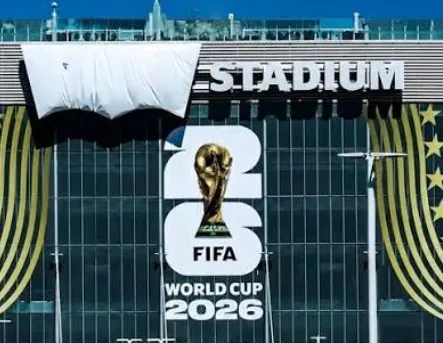
FIFA tried to hide Levi’s Stadium. Levi’s turned the cover-up into free advertising
By Khuzaima Yamman
Jun 25 2026, 3 min read
FIFA’s strict World Cup branding rules were supposed to make Levi’s disappear from its own stadium.
Instead, the denim company may have ended up with one of the most memorable marketing moments of the tournament.
During the World Cup, Levi’s Stadium in Santa Clara has not been operating under its usual name. For FIFA purposes, the home of the San Francisco 49ers has been rebranded as “San Francisco Bay Area Stadium."
That meant the Levi’s name had to come down, or at least be hidden. Large white coverings were placed over the company’s stadium branding, including the familiar exterior signage fans normally see when arriving at the venue.
But the cover-up did not exactly erase the brand.
The white material followed the recognizable shape of the Levi’s logo closely enough that many fans immediately understood what they were looking at. The wordmark was gone, but the silhouette remained. In a tournament where FIFA is trying to tightly control every inch of sponsor visibility, Levi’s managed to stay visible without technically being visible at all.
Then the company leaned into the joke.
Levi’s changed its social media profile image to a covered-up version of its logo, turning FIFA’s restriction into a punchline. The brand also extended the gag beyond the stadium, placing similar white coverings on storefronts in cities around the world. What began as a compliance measure quickly became a global campaign built around the idea that even when the name is hidden, the brand is still obvious.
It is the kind of marketing win that brands usually spend months planning. This one was practically handed to Levi’s by FIFA.
For FIFA, the logic is simple. If a company is not an official World Cup partner, it should not receive free exposure during one of the most-watched sporting events on the planet.
For Levi’s, however, the situation was unusually awkward. The company has paid heavily to attach its name to the 49ers’ stadium, including a long-term naming-rights agreement that runs deep into the future. Yet during the World Cup, that valuable real estate became subject to FIFA’s commercial rules.
The funny part is that FIFA’s attempt to remove the brand may have made people talk about it more.
A fully visible Levi’s sign would have been ordinary. A covered Levi’s sign became a story. Fans shared it, marketers praised it and the company found a way to make the restriction feel playful rather than punitive. By doing almost nothing more than embracing the absurdity, Levi’s turned a blocked logo into a brand asset.
It also showed the limits of strict sponsorship control. FIFA can cover a word. It can rename a stadium. It can tape over logos. What it cannot easily cover is brand recognition built over decades.
The shape of the Levi’s logo did most of the work. No slogan was needed. No official statement was required. The missing name became the message.
That is why the moment landed. It was not a direct fight with FIFA, and it did not appear to violate the rules. Levi’s simply made the restriction itself part of the campaign.